In the modern, highly regulated and competitive manufacturing environment, product identification is no longer just a best practice – it’s a legal requirement and a vital component of brand integrity. A Batch Coding Machine is a critical piece of equipment in any manufacturing process. It guarantees that vital product details – such as date of manufacture, use-by date, batch numbers, and MRP – are accurately and indelibly marked on each product as it exits the plant.
If you are a food or beverage manufacturer, pharmaceuticals, cosmetics, agrochemicals, or FMCG, a batch coding machine is the link between your production line and ensuring your products meet regulatory standards and protect your brand’s reputation. In this guide, you’ll learn all about batch coding machines: their functionality, most common applications, factors to consider when purchasing one, and how SH Hitech Coding Private Limited has become a leading supplier of coding and marking solutions for manufacturers in India.
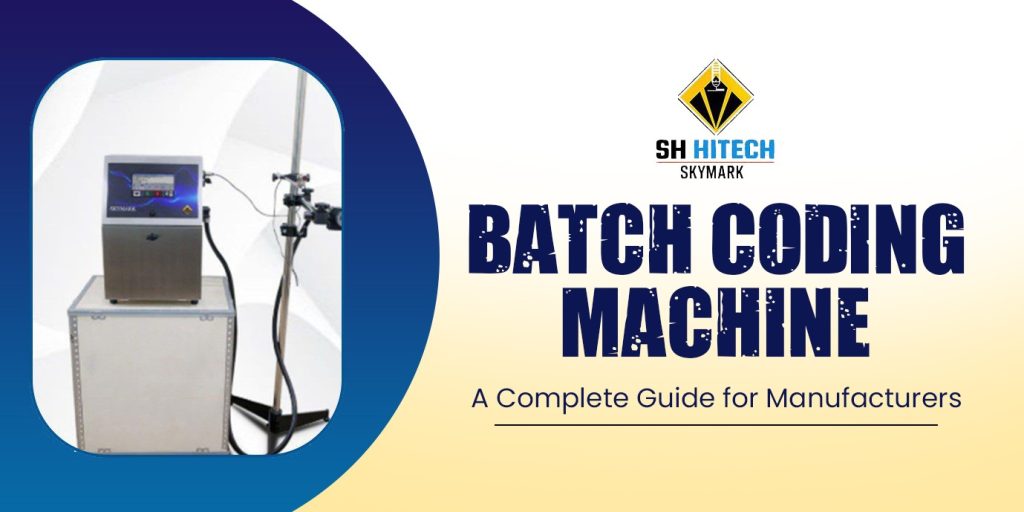
What Is a Batch Coding Machine?
A batch coding machine is an industrial printing equipment that applies variable data to products, packaging, labels, bottles, pouches, cartons and other substrates. This is in contrast to fixed labels, where batch coding enables manufacturers to print variable data that changes for every batch of products, such as the date of manufacture, best before date, batch number, shift code and MRP.
It works on a conveyor line (inline) or stand-alone (offline). Today’s batch coding machines use various printing technologies such as inkjet, thermal transfer, laser, and hot foil stamping, and are capable of printing on a broad range of products and at high speeds.
Put simply, a batch coding machine is the last safety net that confirms the batch of products is properly identified, traceable and ready for consumers.
The importance of Batch Coding
Government agencies like FSSAI, FDA, BIS and state governments require products to bear particular codes. Non-compliance can lead to recalls, fines or even shutdowns. But the advantages of batch coding go beyond regulatory requirements:- Traceability for supply chain management – know when and where product was produced.
- Consumer safety – quickly recall product if a problem is found with a particular batch.
- Product authentication – avoid counterfeits by individually coding each product.
- Warehouse management – enable efficient handling in distribution centres.
- International regulations – comply with export marking requirements.
Types of Batch Coding Machines
There are a range of different types of batch coding machines. The best choice will depend on the material you’re coding, production volume, ink type, and cost considerations. The most common technologies are:
1. Continuous Inkjet (CIJ) Printers
The most common technology for high-speed lines. CIJ printers spray a continuous line of ink droplets, which are diverted to create characters on the product. Suitable for printing on bottles, cans, pipes, cables, and wires at high speeds (over 1,000 units per minute).
2. Thermal Inkjet (TIJ) Coding Machines
Thermal inkjet coding machines generate heat to vaporise ink and then shoot the droplets onto the material. TIJ coders print with high quality for pharmaceutical cartons, labels and cosmetic packaging with high legibility.
3. Laser Coding Machines
Laser coders employ a laser beam to burn or vaporise the product surface to create a permanent, smudge-resistant code, with no consumables. Commonly used in beverages, automotive, and electronics for secure, durable marks.
4. Thermal Transfer Overprinting (TTO) Machines
TTO machines employ a heat printhead and ribbon to print ink onto flexible packaging like bags, films and wraps. Widely used in the food packaging, dairy and FMCG industries for high-quality date and barcode coding.
5. Hot Foil / Pad Coding Machines
Old-fashioned batch coding machines that print information using a hot die and a foil ribbon, onto labels, sachets and folding cartons. Popular in the pharmaceutical and ayurvedic product industries because of their ease of use and affordability.
Where Batch Coding Machines Are Used
A batch coding machine is essential to a wide range of industries. The following are the major industries where coding and marking are critical:
- Food & Beverage – Best before date, lot number, and nutritional information on bottles, pouches, jars and cartons.
- Medicine & Healthcare – Lot numbers, Use-by dates, and serialisation on strip packs, vials, bottles, and cartons.
- Cosmetics & Personal Care – Maximum Retail Price (MRP), date of manufacture and ingredient lot numbers on tubes, bottles and sachets.
- Agrochemicals – Chemical batch, safety, and regulatory compliant coding on bottles, drums.
- FMCG & Retail – Barcodes, price, and promotional coding and date stamping on labels, wrappers and secondary packaging.
- Cables & Pipes – Continuous marking of length, manufacturer information, and product specification codes on extruded products.
- Automotive – Part number, VIN, and date of manufacture on parts and assemblies.
Selecting the Right Batch Coding Machine
When choosing a batch coding machine, it’s important to consider your production needs, packaging material, and total cost of ownership. Consider these aspects:
- Substrate Compatibility: Can the machine print codes on your packaging – glass, plastic, metal, film or paper?
- Speed: Ensure the machine speed corresponds to the speed of your line.
- Print Resolution: Use higher-resolution codes for barcodes, QR codes and pharmaceutical product serialization.
- Ink & Supply Costs: Consider the cost of inks, solvents, ribbons or foils in the lifetime of the machine.
- Integration: Select a machine that will readily integrate with your conveyor and ERP systems.
- Service & Support: Work with a vendor that provides installation, training and responsive service.
Future Trends in Product Coding Technology
Industrial coding technology continues to evolve as manufacturing processes become more automated and digitally connected. Modern coding machines are increasingly integrated with smart manufacturing systems that enable real-time monitoring and production data management.
Future innovations may include eco-friendly ink technologies, improved laser marking solutions, and advanced barcode printing systems. As industries move toward smart factories, coding systems will continue to play a critical role in maintaining product traceability and supply chain transparency.
Role of SH Hitech Coding Private Limited in Industrial Coding Solutions
Choosing the right coding technology provider is critical for manufacturers seeking reliable packaging solutions. SH Hitech Coding Private Limited offers advanced industrial coding equipment designed for modern production environments. The company specializes in providing high-performance coding machines that support high-speed manufacturing processes.
Their solutions are designed to deliver consistent printing results, minimal maintenance requirements, and reliable operation across different packaging materials. By working closely with manufacturers, SH Hitech Coding Private Limited helps businesses implement efficient coding systems that improve packaging productivity and product traceability.
Conclusion
In modern manufacturing industries, accurate product identification is essential for maintaining quality control, regulatory compliance, and efficient supply chain operations. Automated coding systems ensure that every product is clearly marked with important information such as manufacturing dates, expiry dates, and batch numbers.
Technologies like Batch Coding Machines enable manufacturers to achieve high-speed production while maintaining consistent and reliable product coding. With the support of experienced providers like SH Hitech Coding Private Limited, businesses can implement advanced coding solutions that improve packaging efficiency, ensure regulatory compliance, and strengthen product traceability across industries.
📩 Email: contact@shhitech.in
📞 Phone: +91-9011116630 | +91 9112711560
🌐 Website: https://shhitech.in/