
In today’s manufacturing world, every product that makes it to the consumer must be clearly and correctly labelled with information such as date codes, batch numbers, barcodes, serial numbers and regulatory symbols. Of all the coding and marking systems available to manufacturers today, CIJ printers (Continuous Inkjet Printers) are the most widely installed, versatile and reliable solution for high-speed inline coding in almost every industry.
CIJ printers operate by directing a continuous stream of charged ink droplets, selectively deflected by an electric field to create characters, numbers, barcodes, and graphics on a product surface as it passes through the printer – all without ever coming into contact with the product. This makes for a high-speed, consistent, versatile coding solution that can mark almost any product at high speeds.
In this blog, we’ll highlight the benefits of adopting these printers in production settings, the industry’s most reliant on them, and why they’re the go-to choice for manufacturers looking for a reliable, affordable and versatile coding system.
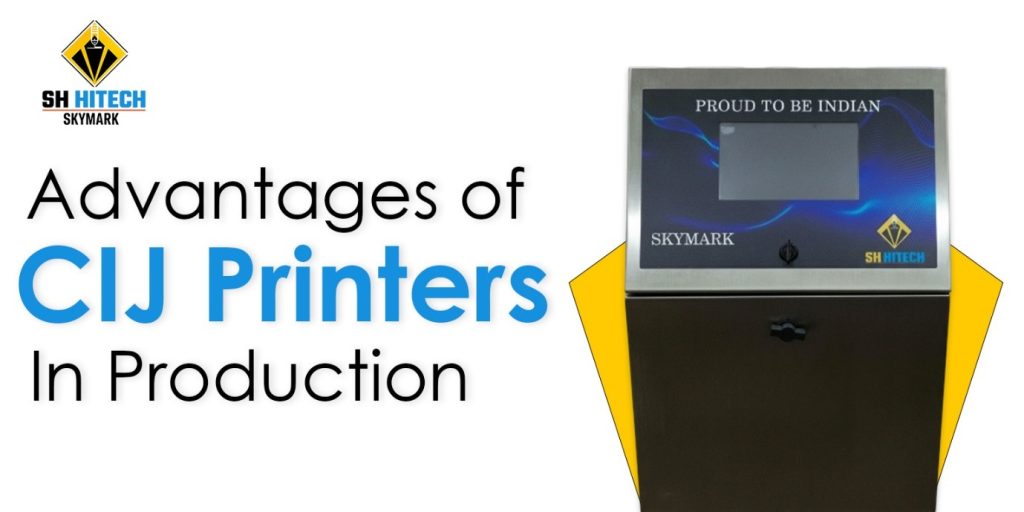
What Are CIJ Printers?
Continuous Inkjet Printers (CIJ printers) are non-contact industrial printers that produce a continuous stream of ink droplets through a tiny nozzle. The droplet is charged, and then passed between deflection plates which determine whether it lands on the product, or is recycled into the gutter. This occurs thousands of times every second, enabling these printers to accurately print a clear and legible code on products moving at high speed, with no need to halt the production line.
CIJ printers can print on non-flat, curved or contoured surfaces from a distance of up to a few millimetres, making them ideal for a broader range of packaging formats and materials than most other coding technologies. Their high speed, continuous printing with low downtime for maintenance and setup has established them as the preferred global method of production line coding in the food and beverage, pharmaceutical, cosmetics, automotive and FMCG industries.
Key Advantages of CIJ Printers in Production
1. Exceptional Production Speed
The first and foremost benefit of these printers is their capacity to operate at very high speeds (up to 1,000 units per minute) without compromising on the quality and precision of the print. Because the printhead is not in contact with the product, there is no physical limit to the speed of the product passing under the printhead. As a result, these printers are the best choice for coding and marking high-speed production lines in food and beverage, dairy and soft drink industries where line speeds are among the highest.
2. Printing on Any Surface without Contact
CIJ printers do not come into contact with the product. This enables them to print on an extensive variety of products – from glass bottles and PET bottles to aluminium cans, cardboard cartons, plastic tubes, rubber hosing, metal parts, ceramic tiles and even the cable sheathing. These printers can code products of any shape, texture or finish without causing damage, making them the most versatile coding technology available.
3. Low Downtime for Continuous Operation
Unlike other methods of coding which need to be stopped frequently for printhead cleaning, ribbon or cartridge replacement, these printers are designed for 24/7 operation. The ink recirculation system ensures the nozzles are kept clear during printing, self-cleaning can be scheduled and ink can be topped up without stopping the printer. These printers’ high uptime translates into more production hours for manufacturers with multi-shift operations and minimised maintenance downtime.
4. Versatile Inks for all Applications
CIJ printers work with a wide variety of inks, making it possible to print on just about any substrate, in just about any environment. There are inks that dry quickly for absorbent surfaces, solvent-resistant inks for chemical environments, pigmented white or yellow inks for dark backgrounds, food-grade inks for packaging that will come in direct contact with food, UV-fluorescent inks for security applications, and high-temperature inks for products that are subjected to ovens or sterilisation processes after printing.
This flexibility in ink formulations allows one CIJ printer platform to code several packaging lines in a plant, simply by changing the ink formulation for each product line.
5. Low Cost of Operation
Over the life of the printer, CIJ printers have one of the lowest cost per code of any high-speed coder. The recirculation system reuses ink droplets that are not used, and the system operates at high ink efficiency. Make-up fluid replenishes solvent to keep the ink at the correct viscosity. The cost of consumables – inks and make-up fluid – is predictable and easy to budget, and the long life of the new generation of these printers minimises the cost of maintenance.
6. Easy Integration to Production Lines
CIJ printers are all about quick and easy integration with existing conveyors, packaging equipment, and production control systems. Nearly all these printers today have user-friendly touchscreen displays, built-in message templates, and communication ports such as Ethernet, USB and serial to link to Enterprise Resource Planning (ERP) and Manufacturing Execution Systems (MES). This means batch numbers, date codes and other product-specific codes can be uploaded automatically from a central computer system, removing the need for manual data entry at the printer and ensuring product codes are accurate and free from errors introduced by human error.
7. Lightweight and Versatile Printhead
The printhead of a CIJ printer is small and lightweight, and is connected to the main unit via a flexible umbilical cord – this enables the printhead to be positioned exactly where it is needed on the packaging line, regardless of the type of packaging or conveyor system being used. Several printheads can be linked to a single control unit, allowing them to print on multiple surfaces of products or multiple packaging lanes.
8. Traceability and Compliance
CIJ printers are essential to helping manufacturers meet their traceability and regulatory compliance requirements. These printers track each unit through the production line by printing batch numbers, manufacturing dates, expiry dates, lot codes and barcodes – ensuring that every product is identified and traceable, which allows quick and accurate recalls if required and compliance with FSSAI, FDA, BIS and other standards.
Industries That Rely on CIJ Printers
CIJ printers are used across a broad range of industries that require high-speed, consistent and versatile printing solutions:
- Food & Beverage: High-speed date coding, lot codes and batch codes for nutritional labelling on bottles, cans, cartons, pouches, trays, and more.
- Military: Batch numbers and use-by dates on bottles, cans, and other packaging on processed dairy lines.
- Medicines: Batch code, expiry, and control code marking on blister packs, ampoules, vials and outer cartons.
- Cosmetics & Personal Care: MRP, date of manufacture and lot numbers on bottles, tubes and jars on high-speed cosmetic packaging lines.
- Cables & Pipes: Continuous-flow branding, manufacturer information, and specification codes on extruded cables, pipes and hoses.
- Automotive Parts: Component ID, date of manufacture, and serial numbers on rubber, metal and plastic parts.
- Crop Protection: Date of compliance and batch coding on bottles, drums and jerry cans for agricultural chemicals.
Conclusion
The fact that CIJ printers are the most commonly used production coding system in the world has been due to the combination of speed, flexibility, reliability and affordability that no other technology has been able to match, across the many and varied applications of industrial manufacturing.
Whether it’s for the very high-speed production lines of the food and beverage industry (over a thousand units per minute), for the pharmaceutical industry where compliant, precise batch coding is required, or for the labels of automotive components, dairy products, cables, cosmetics and many other products, these printers deliver high-quality, consistent and reliable codes on any substrate, in any environment and at any speed.
If a manufacturer is looking to upgrade their existing capabilities, improve compliance, lower their operational costs and increase production line uptime, then purchasing a quality printer from an established, specialist manufacturer with in-depth understanding of the industry and its regulatory environment and excellent after-sales service is a wise move. The benefits of using CIJ printers in the production environment are not just technical, but strategic, operational and economic.
Talk to Our Coding Machine Experts Today
📩 Email: contact@shhitech.in
📞 Phone: +91-9011116630 | +91 9112711560
🌐 Website: https://shhitech.in/