
In the current highly regulated and competitive manufacturing environment, product identification is no longer optional – it is mandatory, required, and demanded by consumers. All products must be labelled with accurate, legible, and properly printed batch numbers, manufacturing dates, expiry dates, serial numbers, MRP and regulatory codes. But while traditional inline coders are well suited for high-speed production, there are a variety of applications that require a mobile coding solution. That’s where the handheld inkjet printer shines.
A handheld inkjet printer is a lightweight, wireless and mobile coding system that enables operators to code variable information on products and packaging, surfaces and materials wherever they are – right on the production line, in the warehouse, on a construction site or even out in the field. This means that a handheld inkjet printer doesn’t need a conveyor, a mounting panel, or a production line. All the operator has to do is point and print – making it one of the most flexible and versatile tools for coding in the manufacturer’s arsenal.
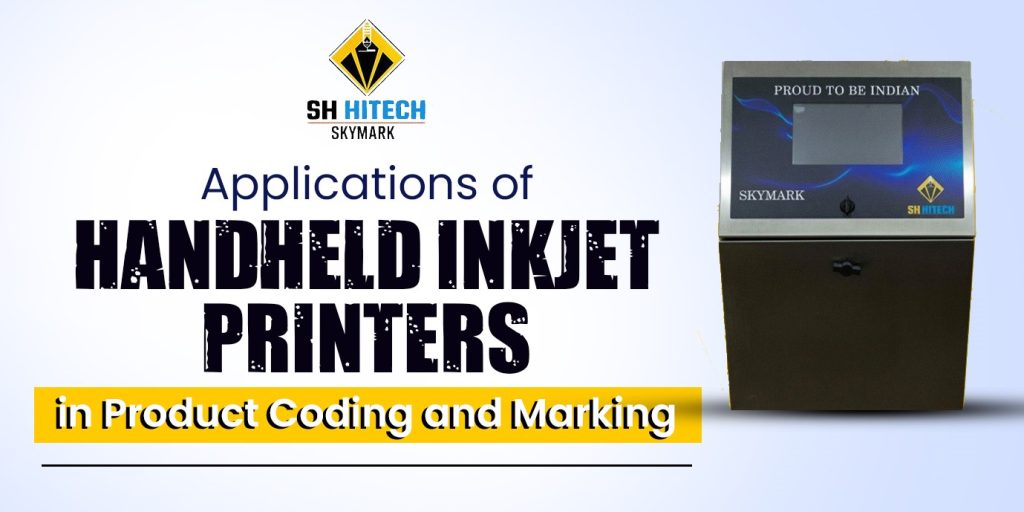
What Is a Handheld Inkjet Printer?
A handheld inkjet printer is a battery-operated, mobile coding device that applies text, numbers, dates, barcodes, QR codes, logos, and other variable information to just about any surface – without the product being placed on a conveyor or in a fixture. The device is held in the hand, brought up to the surface and the trigger pulled. The printhead moves across the surface forming characters with a dot-matrix or high-resolution pattern of ink.
Contemporary handheld inkjet printers have user-friendly digital displays, programmable message templates, and memory that enables a range of different print formats to be stored and called up at will. They use fast-drying inks in colours such as black, blue, white and red, for both porous and non-porous substrates. The handheld inkjet printer prints between a few millimetres and 25 mm or more in a single pass, and is designed to deliver the printing speed, flexibility, and portability needed by manufacturers who don’t have a permanent production line set up.
The Many Uses of Handheld Inkjet Printers in Product Coding
1. Date / Batch Coding of Packaging
The most common use of a handheld inkjet printer is to apply manufacturing date, due date and batch codes on products. Where there is no inline coder to print date and batch on the production line, or where product needs to be re-coded due to a packaging change, the handheld inkjet printer can easily print compliant date and batch on cartons, pouches, bottles, jars, drums, and sacks – directly from the factory floor without halting production.
2. Warehouse and Logistics Marking
In logistics and warehouses, the handheld inkjet printer is used to mark pallets, cartons and crates with shipping information, destination codes, weight, handling warnings and tracking barcodes. Because this labelling takes place after the goods have been packed and palletised, and often in remote locations away from fixed, in-line coders, a mobile handheld inkjet printer is the only option. SH Hitech Coding Private Limited provides handheld printers carefully selected for quick drying inks and readability on corrugated box and stretch-wrapped pallet surfaces.
3. Building Materials and Products
In the construction industry, handheld inkjet printers are widely used to mark bricks, concrete blocks, timber, steel sections, pipes, and cables with specification codes, grade markings, manufacturer names, batch numbers and other information. Such products are bulky, heavy and difficult to transport through a fixed inline coder. Using a handheld inkjet printer, materials can be marked quickly and individually in the production area, yard, or at the job site.
4. Pipe and Cable Marking
Pipes, conduits and cables need to be clearly identified with permanent markings that stay put for the life of the product. A portable inkjet printer can print part numbers, manufacturer identification, date of production and compliance information directly onto the rounded surfaces of pipes and cables – either in the factory or on site – using quick-drying, solvent-resistant inks that withstand contact with plastic, rubber and metal surfaces.
5. Marking Food and Agricultural Produce
Fresh produce, packaged food and other agricultural products must often be marked with a date or origin code, or compliance code that is applied at the time of packing – sometimes in remote areas with little or no fixed infrastructure. A mobile inkjet printer allows packing personnel to apply fast-drying, food-safe date and batch information to crates, trays and outer packaging in a fast and efficient manner from any location, ensuring complete regulatory compliance without the need to set up a production line.
6. Pharmaceutical and Medical Product Labelling
Primary, secondary and tertiary packaging in the pharmaceutical industry must include batch and lot numbers. The use of a handheld inkjet printer by pharmaceutical manufacturers and distributors to apply or re-apply batch and lot numbers and expiry dates to their outer cartons, master cases, and bulk containers – often during packaging, re-packaging, re-labelling or market-specific compliance work – is fast and eliminates the need for costly fixed equipment.
7. Marking Metal, Timber and Industrial Components
Manufacturers of steel billets, structural steel sections, timber boards, and machined components apply heat numbers, grade numbers, specification numbers and identification codes to their product prior to shipment using a handheld inkjet printer. These codes are used to track the quality through the supply chain and are mandated by many quality and industry standards in the steel, timber and engineering industries.
8. Retail and POS Price Coding
Retailers, distributors and importers use handheld inkjet printers to apply or re-apply MRP, pricing and promotional codes on products at the point of receipt or display – fast, accurately and without the need for fixed equipment. This is especially helpful for price change, sale, and promotional coding on bulk stock.
The Benefits of Handheld Inkjet Printers
The use of handheld inkjet printers is increasing in many industries due to a number of operational benefits over manual marking and fixed coding solutions:
- Portable: Lightweight battery-powered unit, coding on production line, in warehouse, at loading dock, in the field.
- No Setup: No conveyor, bracket or production line needed. Just point and click, print on any surface.
- Quick Setup and Printing: Ready-to-go message templates enable instant format changeovers, reducing downtime.
- Versatile Printing Surface: Prints on cardboard, wood, metal, plastic, glass, fabric, rubber and concrete with suitable inks.
- Variable Data Printing: Dates, batch numbers, barcodes, QR codes, serial numbers, logos and other text can be printed on the same machine.
- Affordable: Capital cost is a small fraction of fixed inline coders, low cost consumables and easy maintenance.
- FSSAI, BIS, FDA, and Export Compliance: Allows manufacturers to comply with FSSAI, BIS, FDA, and export market codes, by printing them quickly and accurately at any stage of the production and supply chain processes.
Conclusion
The handheld inkjet printer is a vital coding device used in manufacturing, logistics, construction, food and beverage, pharmaceuticals, and retail – because it offers mobility, versatility and print quality that no other fixed coding system can match outside the controlled environment of a production line.
Whether it’s printing date codes for regulatory compliance on packaged products, coding structural steel on the construction site, applying barcodes for logistics and tracking on warehouse pallets, or re-coding pharmaceutical outer cartons in a compliance update, the handheld inkjet printer answers coding challenges that occur beyond the boundaries of fixed, integrated coding systems – in a timely, cost-effective and print-quality way.
SH Hitech Coding Private Limited provides the best-in-class experience, product selection and after-sales support to help manufacturers in all industries leverage their investment in a handheld inkjet printer. Talk to SH Hitech for the right handheld coding tool for your job.
Send Your Inquiry for Handheld Inkjet Printer
📩 Email: contact@shhitech.in📞 Phone: +91-9011116630 | +91 9112711560
🌐 Website: https://shhitech.in/