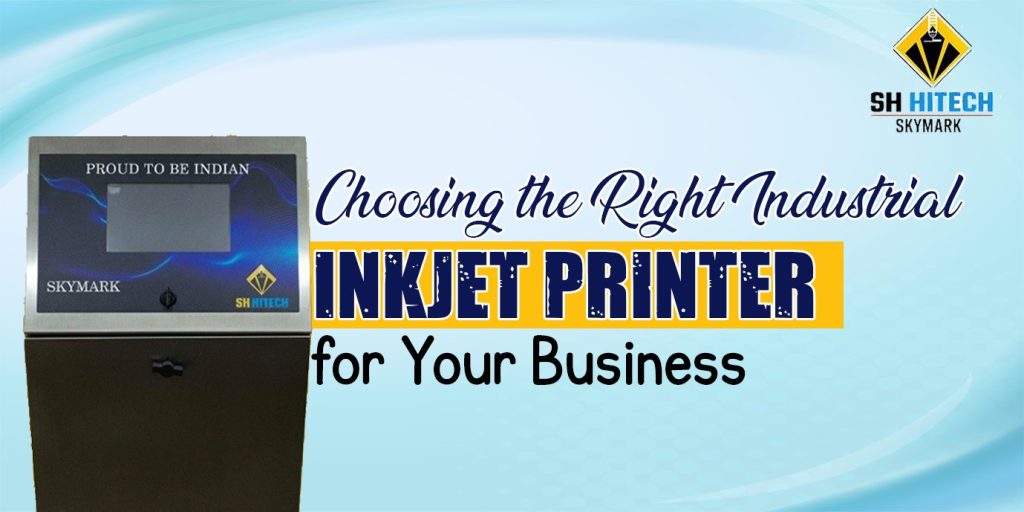
What Is an Industrial Inkjet Printer?
An industrial inkjet printer is a durable, industrial-grade coding system which utilises inkjet printing to apply variable information, such as dates, batch codes, barcodes, serial numbers and logos to products, packaging and industrial substrates during the production line. Unlike desktop inkjet printers that are designed to print on paper, an industrial inkjet printer is engineered to run 24 hours a day, at high speed, in harsh industrial environments – resistant to dust, vibration, heat and chemical exposure, and capable of producing high-quality print with virtually no downtime over millions of print cycles.
Industrial Printing Machine are employed in almost every manufacturing industry – including food and beverage, pharmaceuticals, automobile part production, cable and pipe extrusions, and FMCG packaging. The fact that they can be used to print on many different materials without touching the product’s surface makes them the coding solution of choice for high-speed, large-scale production lines around the globe.
Types of Industrial Inkjet Printers
The first step in choosing the optimal industrial inkjet printer for your operation is to be familiar with the various types of printers on the market:
1. Continuous Inkjet (CIJ) Printers
CIJ Printers is the most common type of industrial inkjet printer in the world. They selectively deflect charged ink droplets in a continuous stream to create characters on a product – without contacting the product. CIJ printers are very fast, produce a wide variety of ink chemistries, and can print on complex surfaces from a distance. They’re the industry standard for high-throughput food and beverage, dairy, cable and pharmaceutical packaging.
2. Thermal Inkjet (TIJ) Printers
TIJ industrial inkjet printers rely on heat to vaporise the ink and eject high-resolution droplet. They offer better quality and resolution than CIJ – and are well suited for printing barcodes, QR codes and complex graphics on cartons, labels and pharmaceutical containers. TIJ printers don’t have any moving parts in the printhead, have low maintenance, and are suitable for clean room and pharmaceutical applications.
3. Large Character Inkjet Printers
Industrial inkjet printers that print large characters (20 mm to 150 mm tall) on outer cartons, pallets, sacks and bulk containers are known as large character inkjet printers. These printers employ valve-jet or piezoelectric printheads and are often used to print shipping addresses, pallet barcodes, weight labels and handling instructions on secondary and tertiary packaging.
4. High-Resolution Inkjet (HIJ) Printers
HIJ printers offer extremely high resolution (greater than 300 DPI) and can be used to print detailed graphics, logos, and compliance labels directly on primary packaging. They are commonly used in label printing, carton printing and high-end packaging applications where high quality print is crucial.
Top Considerations for Industrial Inkjet Printers
When choosing an industrial inkjet printer for your packaging application, it’s important to conduct a systematic assessment of your production conditions, packaging needs and business objectives. Here’s what buyers need to consider:
1. Packaging Substrate
The packaging substrate you want to print on is the most critical factor in choosing the type of Industrial Marking Printer to use. CIJ printers are great for bottles, cans, pipes and cables. TIJ printers are best suited for cartons and labels. Large character printers work best on outer sacks and pallets. Knowing your substrate type – porous, non-porous, curved, flat, rigid or flexible – helps determine the type of technology you need.
2. Production Line Speed
Your line speed or conveyor speed dictates the minimum print speed your industrial inkjet system should achieve without degrading the quality of the print. CIJ printers can support speeds of more than 1,000 units per minute, making them a good choice for high-speed food, beverage and cable production. TIJ and large character systems perform well with medium line speeds. Be sure to check that the manufacturer’s speed is equal to or greater than your peak production need with adequate margin.
3. Content and Resolution
What will you be printing – just date codes and batch numbers, or barcodes, QR codes and graphics? For example, if you need high-resolution barcodes and 2D codes, TIJ or HIJ is preferred over CIJ. If you need to print large characters on outer cartons or pallets, an industrial inkjet printer with large characters is the one for you. Specify the right print resolution for your content to avoid the costly error of under-specifying.
4. Ink and Environment
The conditions on your production line (temperature, humidity, chemicals and cleanliness) dictate what type of inks to use on your industrial inkjet printer. Solvent inks that dry quickly are used with non-porous surfaces and high temperatures. Aqueous inks are used with porous substrates and for food-safe packaging. White pigmented inks are required for dark backgrounds. Specify the ink as part of the printer purchase to ensure that the system will work and the ink will adhere to your packaging material.
5. Connectivity and Integration
An Industrial Marking Printer should be able to seamlessly communicate with your production equipment such as conveyors, sensors, product detectors, and even your enterprise resource planning (ERP) and manufacturing execution system (MES). Consider the printer’s connectivity options (Ethernet, USB, serial), integration with your production control software, and how easy it is to upload batch information and product codes from a central database. Integration not only saves time on data entry, but also prevents coding mistakes due to operator error.
6. Total Cost of Ownership
When it comes to the cost of an industrial inkjet printer, the initial purchase price is just the beginning. Consider the ink and make-up fluid usage, the cost and frequency of planned maintenance, the longevity of printheads, availability of spare parts and costs of support contracts. A lower cost inkjet printer which consumes large quantities of consumables and/or requires frequent maintenance can be much more expensive to operate over a five-year lifespan than a high-end inkjet system with reduced operating costs.
7. Service and Support Network
An Industrial Inkjet Coding Machine is a critical piece of production equipment. If it breaks down, so does your production. Before buying, check that your supplier has a local service network, service engineers, spare parts and a service level agreement (SLA) that assures you a quick response in the event of a breakdown. This is one of the areas where SH Hitech Coding Private Limited excels – by offering fast technical support and after-sales service to reduce production downtime for their customers in India.
Conclusion
Selecting the right industrial inkjet printer for your company is by no means a simple choice of the most popular model or the cheapest machine. It demands a full understanding of your production environment, packaging materials, line speed, content needs, integration requirements and cost of ownership – and matching those needs with the technology and model most likely to deliver safe, compliant and cost-efficient operation and performance in your production environment.
Your choice of industrial printer will impact on the efficiency, compliance and brand reputation of your production process for the next ten years or more. Making the right choice, with the help of a knowledgeable, technically competent coding specialist, is the difference between optimal performance and a constant source of headaches.
SH Hitech Coding Private Limited offers the technical know-how, the product portfolio, and the service orientation to help you make the right choices, at every step of the process from application assessment and printer selection through installation, commissioning and ongoing support. Get in touch with SH Hitech to select the right industrial inkjet printer for your needs.
Talk to Our Coding Machine Experts Today📩 Email: contact@shhitech.in
📞 Phone: +91-9011116630 | +91-9112711560
🌐 Website: https://shhitech.in/