Introduction
Consider the most recent packaged item you picked up: a bottle of medicine, a snack pouch, a cosmetic tube or a carton of juice. All of them have written information: a manufacture date, an expiration date, a batch number, and frequently a barcode. This doesn’t happen by accident and in many cases, this is not hand-printed. It was applied automatically, precisely and at high speed by an automatic batch coding machine – one of the most critical and underrated equipment in modern manufacturing.
Nowadays, products sold to consumers have to be identified in a correct and traceable manner. It is required by regulatory authorities like FSSAI, FDA, BIS etc. Retailers demand it. Consumers expect it. The automatic batch coding machine is the industrial solution that allows to satisfy these requirements in a repeatable, scalable and non-disruptive manner.
This guide provides you with a definition of automatic batch coding machine, how it works, what features to expect to find, the industries that use it, and how the right machine can help you streamline and guarantee the efficiency and compliance of your packaging process.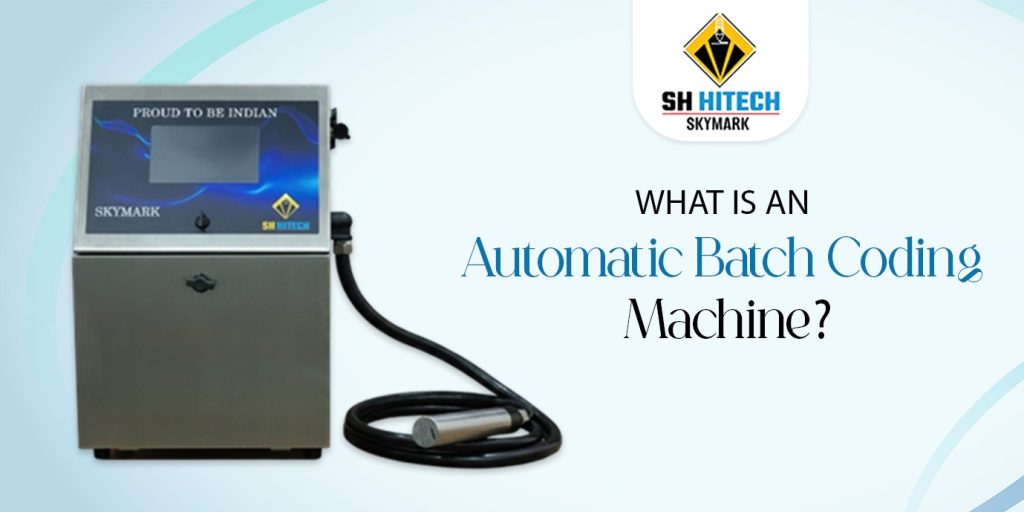
What Is an Automatic Batch Coding Machine?
An automatic batch coding machine is an industrial printing system that integrates directly into a production or packaging line to apply variable data — information that changes from one batch or production run to the next — on products and their packaging, automatically and without requiring an operator to manually handle or print each unit.
The word “automatic” is key here. Unlike a manual coder — where an operator stamps or prints each item individually — or a semi-automatic machine that requires some operator involvement, an automatic batch coding machine operates in continuous synchronisation with the production line. As products move along the conveyor, the machine detects each one using a sensor, fires the printhead at precisely the right moment, and applies the code — all without stopping, slowing, or requiring any operator action between units.
The data it prints changes automatically according to pre-programmed settings. Dates roll over at midnight without anyone touching the machine. Batch numbers update between production runs with a few keystrokes. The result is consistent, accurate, and fully traceable coding across every unit in a batch — whether that is 100 units or 100,000.
Key Features of an Automatic Batch Coding Machine
Modern automatic batch coding machines are sophisticated systems that combine precision engineering with intelligent software. Here are the features that define a high-quality machine:
High-Speed Printing
An automatic batch coding machine is designed to keep pace with the fastest production lines — often printing on more than 1,000 units per minute without any reduction in code quality or accuracy. This speed capability means the coding station never becomes a bottleneck that slows downstream production.
Non-Contact Printing Technology
Most automatic batch coding machines use non-contact printing — the printhead never physically touches the product surface. This allows the machine to code on curved, irregular, delicate, or textured surfaces that would be damaged or incorrectly coded by a contact-based system. It also means the machine can print on products that are moving at varying speeds without any mechanical adjustment.
Programmable Message Templates
A quality automatic batch coding machine allows operators to pre-store multiple message templates — one for each product variant or packaging format. At the start of a new production run, the operator selects the correct template, confirms the date and batch number, and the machine is ready. No manual re-entering of data, no risk of typing the wrong expiry date format, no wasted time.
Automatic Date and Time Updating
The machine’s internal clock updates dates automatically at the correct intervals. This eliminates one of the most common — and most costly — coding errors in manufacturing: products being shipped with yesterday’s date because someone forgot to update the machine at the start of a new shift.
Wide Substrate Compatibility
An automatic batch coding machine can print on an extensive range of packaging materials including glass, PET plastic, HDPE, aluminium, cardboard, flexible laminates, rubber, and paper — with appropriate ink formulations matched to each substrate type.
Integration with Production Systems
Modern automatic batch coding machines connect directly to ERP (Enterprise Resource Planning) and MES (Manufacturing Execution Systems) — the central software platforms that manage production data. This means batch numbers, product codes, and other variable data can flow automatically from the production management system into the coding machine, eliminating manual data entry and ensuring total accuracy.
Types of Automatic Batch Coding Machines
The term automatic batch coding machine covers several distinct printing technologies, each with specific strengths:
Continuous Inkjet (CIJ)
The most widely deployed technology globally. CIJ machines generate a continuous stream of charged ink droplets, selectively deflecting them to form characters on moving products from a standoff distance. Extremely fast, highly versatile across substrates, and capable of using a wide range of ink formulations — from standard black to food-safe white and UV-fluorescent variants. The benchmark choice for food, beverage, dairy, cable, and pharmaceutical production lines.
Thermal Inkjet (TIJ)
TIJ automatic batch coding machines use heat to vaporise ink and fire tiny droplets onto the substrate at high resolution — up to 600 DPI. This produces sharp, detailed codes ideal for barcodes, QR codes, and fine-print compliance marking on cartons and labels. Minimal maintenance, no moving parts in the printhead, and clean operation make TIJ popular for pharmaceutical and clean-room packaging environments.
Laser Coding
Laser-based automatic batch coding machines use a focused beam of light to engrave or ablate a permanent mark on the product surface — with zero ink, zero consumables, and zero smudging. Ideal for glass bottles, PET containers, and products requiring tamper-evident, permanent identification. Higher upfront cost but the lowest ongoing running cost of any technology.
Thermal Transfer Overprinting (TTO)
TTO machines use a heated printhead and a ribbon to transfer high-resolution codes onto flexible packaging films, pouches, and wrappers. Commonly used in food packaging, dairy, and FMCG sectors where high-quality date and barcode printing directly onto the packaging film is required at moderate production speeds.
Benefits of Using an Automatic Batch Coding Machine
Converting from manual or semi-automatic coding to a fully automatic batch coding machine makes it possible to measure benefits in every aspect of production:
- Eliminates Human Error: Automatic date updating, pre-stored templates, and sensor triggered printing eliminate human error.
- Increases Production Speed: Manual handling, pauses and bottlenecks are eliminated as coding proceeds in line with the fastest packaging lines.
- Ensures Regulatory Compliance: Each unit is automatically supplied with a comprehensive, unambiguous and intelligible code – which complies with FSSAI, FDA, BIS and export markets.
- Improves Product Traceability: Unique batch and lot codes allow for a precise, targeted recall and full supply chain traceability.
- Saves Labour Costs: Coding an entire production line in one automatic batch coding machine with minimum operator involvement.
- Reduces total cost of ownership: In addition to initial cost being greater than manual methods, the economies of labour, rework and compliance risk justify the investment in time and money.
Industries That Rely on Automatic Batch Coding Machines
Virtually in all manufacturing and packaging lines the automatic batch coding machine is a standard requirement in the production line.
- Food & Beverage: High-speed date and lot coding, typically at speeds that would be too fast for manual coding, on bottles, cans, cartons, pouches and flexible packaging.
- Pharmaceuticals: Batch numbers, expiry date and serialisation on blister packs, vials, ampoules and outer cartons – where accuracy of print is essential in terms of the regulations and patient safety.
- Cosmetics & Personal Care: MRP and manufacturing date and lot traceability of cosmetics and personal care on tubes, bottles, sachets and jars for brand-sensitive product lines.
- FMCG & Retail Packaging: Price coding, promotional marking and date information on fast-moving, high volume consumer product lines.
- Agrochemicals: Coding on pesticide bottles, fertiliser drums and crop protection pouches to ensure regulatory compliance.
- Cables & Pipes: Cables, conduits and industrial pipes with continuous inline specification and manufacturer coding
Conclusion
An automatic batch coding machine is an essential investment for modern manufacturing industries. It helps improve product traceability, regulatory compliance, production efficiency, and coding accuracy across packaging lines. From high-speed CIJ printers to laser coders and TIJ systems, different technologies are available to meet specific industrial requirements.
Choosing the right automatic batch coding machine depends on factors such as production speed, packaging material, print quality, and industry application. SH Hitech Solutions helps manufacturers across food, beverage, pharmaceutical, FMCG, cosmetics, and industrial sectors select and maintain the most suitable coding and marking solutions for their production needs.
With expert technical support, installation assistance, operator training, and reliable after-sales service, SH Hitech Solutions ensures smooth, accurate, and efficient batch coding operations for businesses across India.
supply perform at its best — every shift, every batch, and every single product. Contact SH Hitech Solutions today to find the right automatic batch coding solution for your business.