Every product that leaves a factory carries a story in its coding — the manufacturing date, batch number, expiry date, or serial number printed on its surface. This small detail is not just cosmetic. It is a legal requirement, a safety assurance, and a fundamental pillar of product traceability in modern industrial operations.
Among the many technologies available for product and packaging coding, the CIJ printer — short for Continuous Inkjet printer — is the most widely adopted in industrial environments worldwide. Its ability to print at high speed on virtually any surface, without physical contact, has made it the go-to solution for food and beverage plants, pharmaceutical facilities, automotive factories, cosmetics lines, and dozens of other industries.
But with a wide range of CIJ printer models, specifications, and suppliers available in the market, choosing the right one for your operation is not always straightforward. The wrong choice can lead to poor print quality, frequent maintenance issues, ink waste, and production downtime.
This guide gives you a clear, structured approach to selecting the right CIJ printer for your industrial packaging needs — covering how the technology works, what to evaluate, and how to avoid the most common selection mistakes.
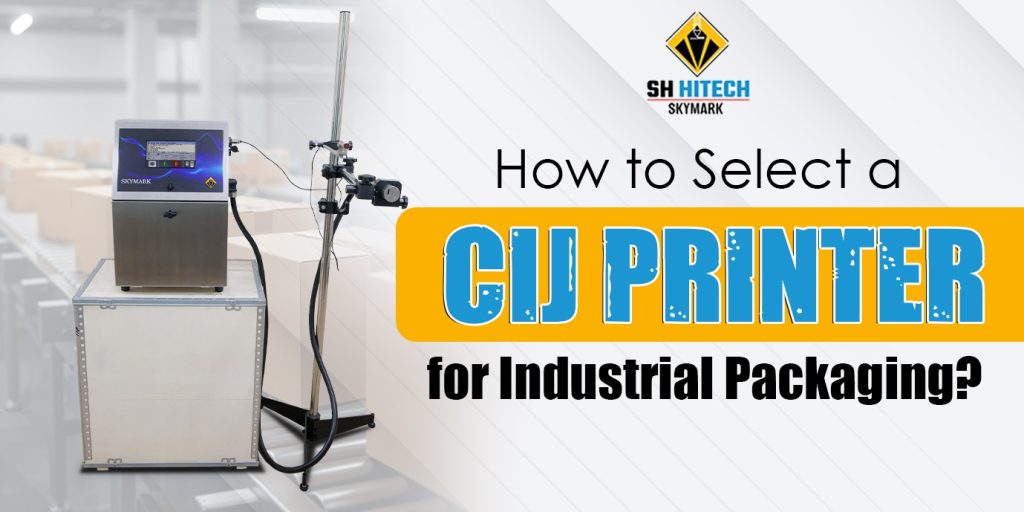
1. How Does a CIJ Printer Work?
Understanding the basic mechanics of a CIJ printer helps you appreciate both its strengths and its limitations — and makes the selection process much more informed.
A CIJ printer works by pumping ink under pressure through a tiny nozzle, which breaks the ink stream into a continuous series of microscopic droplets. Each droplet passes through an electrical charging tunnel, where it receives a precise electrical charge based on the character being printed. The charged droplets are then deflected by high-voltage deflection plates, directing them onto the substrate to form characters, numbers, or symbols. Uncharged droplets are not used for printing and are instead recirculated back into the ink system for reuse.
Key technical advantages of a CIJ printer:
- Non-contact printing — the printhead never touches the surface, making it suitable for delicate, uneven, or moving substrates
- High-speed capability — CIJ printers can print on products moving at speeds of up to several hundred metres per minute
- Versatility across surfaces — compatible with glass, metal, plastic, rubber, cardboard, film, foil, and more
- Continuous operation — designed to run 24 hours a day with minimal interruption
- Wide ink range — available in pigmented, solvent-based, water-based, food-grade, and UV-reactive formulations
These characteristics explain why the CIJ printer remains the dominant coding technology in high-volume industrial packaging environments across the globe.
2. Industries That Rely on CIJ Printers for Packaging
The CIJ printer is trusted across an exceptionally wide range of industries. Understanding where and how it is used gives valuable context for evaluating whether it is the right technology for your specific application.
- Food and Beverage: The food industry is one of the largest users of CIJ printers. From printing best-before dates on dairy products and batch codes on beverage bottles to lot numbers on snack pouches and canned goods, CIJ technology handles the high line speeds and varied surface types that food production demands. Food-grade inks are available for applications involving direct food contact or proximity.
- Pharmaceuticals: In pharmaceutical manufacturing, product coding is a regulatory requirement under GMP (Good Manufacturing Practice) guidelines. CIJ printers are used to print batch numbers, manufacturing dates, and serial codes on vials, blister packs, ampoules, and outer cartons — with full traceability and audit trail capability.
- Cosmetics and Personal Care: Expiry dates, batch references, and product codes on bottles, tubes, jars, and sachets are printed using CIJ printers that can handle the varied shapes and surface finishes common in cosmetics packaging.
- Automotive and Industrial Components: CIJ printers mark part numbers, production dates, and traceability codes on rubber seals, metal components, plastic parts, and cables — using solvent-resistant inks that adhere permanently even in demanding environments.
- Pipes, Cables, and Building Materials: The construction and electrical industries use CIJ printers to print continuous length markings, standards compliance codes, and manufacturer details on cables, pipes, and profiles at high speeds during extrusion.
- Dairy and Agri-Processing: High-speed CIJ printers are essential on dairy packaging lines where bottles, pouches, and cartons move rapidly and require clear, smear-resistant date coding under cold and humid conditions.
3. Nine Key Factors to Evaluate When Selecting a CIJ Printer
Choosing the right CIJ printer requires a structured evaluation across several technical and operational dimensions. Here are the nine most important factors to assess:
- Line Speed Compatibility: The CIJ printer you choose should be able to print as fast or faster as your production line. The Line speed is usually expressed in metres per minute or products per minute. Running at or close to the maximum speed setting of a CIJ printer regularly can result in poor print quality and premature wear. Always choose a machine that has a higher rate than your production line in order to be able to increase production in the future.
- Substrate and Surface Type: CIJ printers are very versatile; however, the adhesion of ink to surface, and the print clarity is different on different surfaces. The effect of glass, metal, smooth plastics and porous materials on inkjet droplets is different. Ensure that the CIJ printer and the ink formulation is validated to print on your packaging material. If several different surfaces are required in products, inspect the machine to see if it has a variety of inks or rapid ink changeovers.
- Print Content and Character Requirements: Think of what you want to print. There is no reason why a simple text, such as dates, batch numbers, alphanumeric codes, etc. cannot be easily printed by any standard CIJ printer. When printing barcodes, 2D Data Matrix codes or logos, verify that the machine’s resolution and drop generation frequency is acceptable for easy scanning and/or printing. The typical height of the characters used in most industrial CIJ print applications is 2mm to 10mm.
- Ink Technology and Compliance: The ink used in a CIJ printer must be appropriate for the industry and application. Inks used in pharmaceutical applications or food applications must conform to the safety requirements set forth for these products. If it is to be used outdoors or as an industrial ink, you need UV resistant and solvent fast inks. Always check that the ink provided by your CIJ printer is locally available, reasonably priced and meets regulatory needs in your industry and target markets.
- Printhead Design and Mounting Flexibility: Printheads from different printers have different physical designs, which in turn can affect how easily they can be installed on your production line. All of the printheads can be mounted on brackets along a conveyor, but they come in a range of sizes, cables lengths and angles. If your packaging line is confined or your printhead needs to be mounted at an unusual angle, check that the CIJ printer will be able to mount the system correctly without compromising on the print quality.
- User Interface and Message Management: The modern CIJ printers should have an easy-to-use touchscreen interface where the operator can easily create, edit and switch between message templates with a minimum of training. If your team is using regional languages, check for pre-built message templates, variable field management (which can be used for automatic date incrementing, counter fields or shift codes), and multi-language support. An effective interface results in operator accuracy and minimises changeover times between product changes.
- Maintenance Design and Ease of Servicing: CIJ printers utilize pressure applied to ink and need maintenance like nozzle cleaning, filter replacement and checking the ink system periodically. In addition to these, some newer CIJ printers are built with features like tool-free maintenance access, self-cleaning nozzle systems and automatic ink viscosity management that can minimize the time and skill needed to perform routine maintenance. Before buying, consider how easy it will be to access all the key serviceable parts, and what the recommended maintenance schedule will be.
- Reliability and Uptime Record: Reliability is a critical factor with a piece of equipment that is supposed to operate 24 hours a day on a production line. Check out MTBF (mean time between failure) for models that you are interested in. Request references from suppliers from other companies in your industry and environment. It is the costlier printer that is known for its high reliability from a top-tier manufacturer that will provide a higher ROI than the lowly printer with poor uptime.
- After-Sales Support and Spare Parts Availability: All machines have their downtime. A running production line means that every minute the CIJ printer is down costs. Make sure that the supplier is able to provide local service engineers, can guarantee response times to emergency calls, and holds a stock of critical spare parts such as printheads, pumps, filters and other components of the ink system. One of the most critical and least considered points when choosing a CIJ printer is after-sales support quality.
4. CIJ Printer vs Other Coding Technologies: When to Choose CIJ
The CIJ printer is not the only coding technology available, and understanding when it is the best choice — and when an alternative may be more appropriate — is an important part of the selection process.
- Choose a CIJ printer when: your production line runs at high speed, you need to print on a variety of non-porous surfaces (glass, metal, plastic), your application involves continuous 24-hour operation, or you need a small-character code (under 10mm height) on primary packaging.
- Consider Thermal Inkjet (TIJ) when: your line speed is moderate, you need high-resolution output for barcodes or logos on cartons, and you prefer a low-maintenance, cartridge-based system with minimal ink handling.
- Consider Laser Coding when: you need permanent, tamper-evident marks without consumable inks, your surface allows laser ablation or engraving, and long-term cost of ownership is the priority.
- Consider Large Character Inkjet when: you are coding outer cartons, corrugated boxes, or pallets with bold, large-format text that must be legible at a distance.
For the majority of primary packaging applications in fast-moving industrial environments, the CIJ printer remains the most versatile, cost-effective, and proven technology available.
5. Common Mistakes to Avoid When Buying a CIJ Printer
Even informed buyers make avoidable errors when purchasing a CIJ printer. Here are the most common pitfalls and how to avoid them:
- Selecting based on purchase price alone without accounting for ink cost, maintenance cost, and downtime risk over a 3–5 year period
- Failing to test the CIJ printer on your actual substrate and ink before finalising the purchase
- Underestimating future line speed requirements and choosing a machine that cannot scale
- Ignoring the quality and responsiveness of the supplier’s after-sales service team
- Not verifying ink compliance with the relevant food, pharmaceutical, or environmental regulations for your industry
- Overlooking integration requirements with your existing PLC, encoder, or production management systems
A qualified CIJ printer supplier will walk you through a structured needs assessment, recommend the right model for your application, and support you through installation, operator training, and ongoing maintenance — ensuring you avoid these costly mistakes entirely.
Conclusion: The Right CIJ Printer Starts with the Right Partner
Selecting the right CIJ printer for your industrial packaging operation is a decision that touches compliance, product quality, operational efficiency, and long-term costs. By understanding how CIJ technology works, evaluating the nine key selection criteria, comparing it with alternative technologies, and avoiding the most common purchasing mistakes, you can make a confident, well-informed decision that serves your production line reliably for years.
For businesses looking for a trusted partner in CIJ printer selection and deployment, SH Hitech Solution brings the expertise and experience needed to get it right. With deep industry knowledge spanning food and beverage, pharmaceutical, cosmetics, automotive, dairy, and industrial manufacturing sectors, SH Hitech Solution provides a comprehensive range of CIJ printers and coding solutions tailored to diverse production environments. From initial needs assessment and equipment selection through to installation, operator training, and ongoing after-sales support, SH Hitech Solution ensures that every client gets the right CIJ printer for their specific application — backed by responsive local service that keeps production moving.
Invest in the right CIJ printer today — and build a packaging line that codes accurately, complies confidently, and runs without interruption.
Request Product Details & Pricing Now
Email: contact@shhitech.in
Phone: +91-9011116630 | +91-9112711560
Website: https://shhitech.in/